







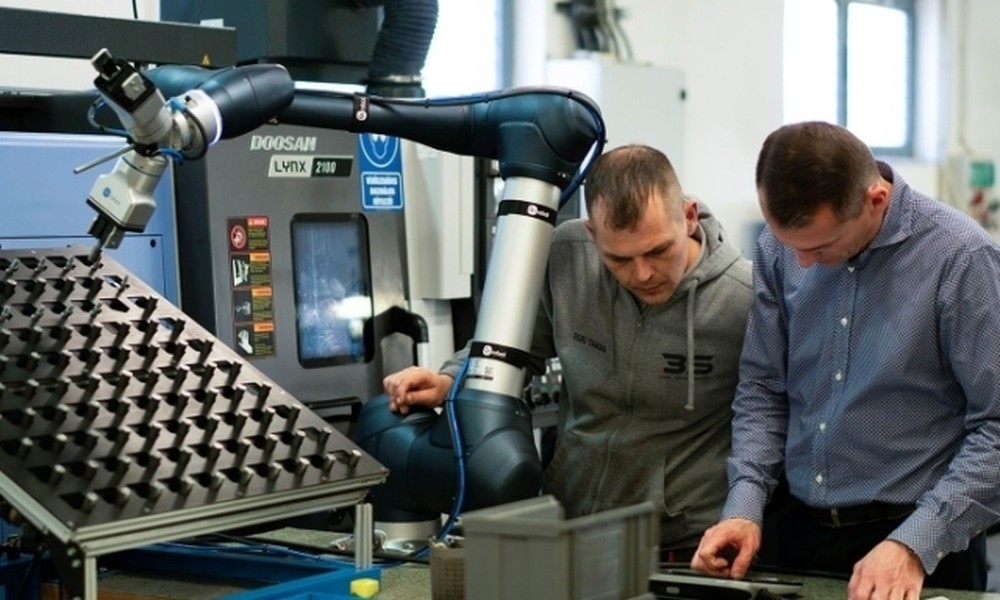
Automation in CNC environments rarely begins with a full-scale transformation. It typically starts with a constrained, repetitive task that exposes inefficiencies embedded in the broader production system. Machine tending fits this role precisely because it sits at the intersection of machining time, operator availability, and workflow continuity. When loading and unloading cycles are manual, even minor inconsistencies in timing create measurable disruptions in spindle utilization. Over time, these micro-delays accumulate into lost capacity that cannot be recovered without structural changes. Introducing automation at this point does not merely replace labor-it stabilizes cycle consistency, which becomes the first measurable layer of optimization.
From Isolated Task to System-Level Impact
Once tending is automated, the dynamics of machine operation begin to shift. CNC equipment, previously constrained by human pacing, can operate closer to its theoretical throughput limits. This exposes secondary inefficiencies that were previously masked, such as suboptimal tool change strategies, poor fixture design, or inconsistent material flow. Automation therefore acts as a diagnostic mechanism, revealing bottlenecks that were not visible under manual operation. In practice, companies implementing solutions such as cnc machine tending often observe that the initial gains in uptime lead directly to questions about upstream and downstream synchronization. This shift in perspective marks the transition from task automation to process optimization.
Data Consistency and Predictability as Optimization Drivers
A critical but often underestimated effect of automated tending is the standardization of operational data. Manual processes introduce variability not only in timing but also in handling, positioning, and even machine start conditions. Automation reduces this variability to a predictable pattern, enabling more reliable data collection and analysis. With consistent cycle times and repeatable interactions, production data becomes actionable rather than indicative. This creates a foundation for more advanced optimization strategies, including predictive maintenance and adaptive scheduling. Without this baseline consistency, higher-level digital tools often fail to deliver meaningful results, as they rely on stable input parameters.
Integration with Broader Automation Architectures
Machine tending does not operate in isolation once implemented. It naturally connects with other elements of the production environment, including conveyors, storage systems, and inspection units. These connections gradually transform a single automated cell into part of a coordinated system. The key observation is that integration pressure emerges organically: once one machine operates autonomously, manual intervention in adjacent steps becomes a limiting factor. As a result, companies are incentivized to extend automation horizontally, linking processes that were previously fragmented. This expansion is rarely driven by strategic planning alone; it is often a direct consequence of resolving the constraints uncovered during initial CNC automation.
Organizational Implications and Decision-Making
Adopting CNC machine tending also reshapes decision-making at the operational level. Managers move from reactive scheduling, driven by operator availability, to capacity planning based on machine performance. Maintenance teams gain clearer insight into wear patterns due to consistent operating conditions. Engineers, in turn, can refine process parameters with greater confidence, knowing that external variability has been minimized. These changes alter how production systems are evaluated, shifting the focus from labor allocation to system efficiency. Over time, this leads to a more analytical approach to investment decisions, where automation is assessed not as a standalone upgrade but as a lever for systemic improvement.